


Wooden it be nice?
Updated: Mar 13
Ok I have a little time on my hands as the shop is currently 8 degrees and I am justifying my procrastination by developing customer relations through storytelling. Musical instruments are very personal, and having been a keeper of a few subpar instruments throughout my life, I find that in the stories they hold, there is a richness and depth that give meaning to me each time I open up the case and in my playing. I have a fiddle that I bought at a flea market in the late 80's for 75.00. It had metal tuners, and though I consider them declasse, I really liked the idea of humidity proof tuners as I was always playing in either outside damp, or wicked, negative humidity, woodstove heat. This fiddle accompanied me over several corners of the world when I was a low brow, vaudeville entertainer in my 30's. Its the fiddle I played for Tina Turner and Joe Cocker when they and I were guests on Australia's version of the Gong Show called "Red faces" on "Hey, Hey, Its Saturday night" a long running institution of Saturday evening TV entertainment for 1/3rd of Australia in its day. It's also the fiddle I played for my sister's elementary school when the kids were coming in in the morning with their parents. One of the parents was Paul Simon. I was ready with an extra guitar and I asked him if he would want to jam some Old time. He graciously agreed, and he was pretty good. Afterwards I asked him if he would sign my fiddle with my pocket knife. He said he didn't have the heart to do that. I told him that it was a 75.00 fiddle, and if he signed it it would be worth at least twice that. He laughed and consented. That's a long winded justification for telling you a little bit about the stories that makes up instruments like I hope you have someday with your Wiplstix.


I don't buy in any wood. I did a long time ago when I used curly red maple and birdseye sugar maple for a little eye candy. I will say that the softer red maple was equivalent to the black walnut in sound quality for this particular instrument. The harder traditional woods like maple are too brash for the small sound cavity. Walnut is just so clearly the best. I don't need to stain it, it's stable and lightweight, and I can harvest it right out my door. It grows fast as an early succession tree, meaning its one of the first trees that comes up in an overgrown field in the limestone karst where I live and grows fast. In my other life, Asheville Nuttery, Black Walnut is the bread and butter of our native nut processing and is a poster child for a model of native, perennial agroforestry based agriculture (see also Acornucopia project) that uses minimal chemical inputs, supports native species diversity, produces the highest quality, nutrient dense food, and with no cultivation that goes with annual commodity farming which is rapidly spinning us down a cesspool of soil and water degradation and excessive Co2 release. So if I haven't been caught up on fiddle making, its because I'm tinkering with ways to make walnut processing efficient enough to be an economically viable template for small regional nutteries enhancing food resiliency. (Man you can tell that it's still cold in the shop because I keep digressing) I cant really sing the praises of black walnut enough, and how many people are aware of the attributes of the trees that their instruments are made of?!
Most of the fiddles in this next batch came from a tree growing 6' from the southwest corner of the Wiplstix international headquarters. I cut down the black walnut by my shop in 2022 that had been a dear protector and friend of mine during my 40 year tenure on this farm. The reason I did this was I grafted an "improved" walnut onto one of its seedlings growing in a nearby hedge hedge. The graft had grown enough as a the bigger tree was shading it out. So I cut the big one down to open up sunlight for the improved variety to induce nut production for food.

For the insatiably curious, an "improved walnut" means that a variety was found out in the wild that had better attributes for processing like a thinner shell, more meat/ shell ration, productivity, disease resistance, ease of meat release from the shell after cracking. Just like an improved apple may be found and grafted onto a poor quality crab apple. This particular variety called "Hay" was recommended to me by an elder in the Northern Nut Growers Association which is a venerable organization of 100 years plus, made up of oddballs like me, that think there is a relevant future for our native nuts in the American lexicon of food. (Now I'm really down a rat hole and I started a fire in the shop). Needless to say, black walnut is an amazing tree and I am proud that I process it for nut meats, nut oil, and travelling instruments.
Spruce: The top/ soundboard of the Wiplstix is a mere 2.5 mm thick and it is flat, not arched like a traditional fiddle for several reason. One being an arch on that small of span supporting the bridge is not needed structurally. The biggest reason is that it keeps the cost down to you and I need all the head space I can muster for the bridge. I've played with using red cedar and it looks spectacular, but I think it is too soft as a material as makes too soft a sound. It's warm but suffers projection. That said, I have some ancient eastern white cedar I cut up as a fallen tree nearly 40 years ago and sawed into boards originally to fix an old cedar canvas canoe I was renovating. As of the writing of this I believe I will put a couple of those on this next batch of fiddles (ask me how I think it sounds). The exception about using this cedar vs the red cedar is that the white cedar grain is so tight ( count them with a razor on the outer rings of the log) that it might actually be dense enough.
(Is slow grown hard wood (deciduous) is less dense than fast grown?... why would the opposite be true of softwoods (conifers)?
Some of the spruce I use for Wiplstix tops are:
Engleman Spruce from the rocky mountains in Washington/ Idaho
Sitka Spruce from the coastal ranges of Washington state
Red Spruce from Cheat Mountain, West Virginia
White Spruce from Ontario
They all have their story as well...
Engleman Spruce: Probably the least interesting story, but the one the next batch of fiddles is being made from so I think best to showcase it for its relevancy. I used to go out west in my youthful impetuousness to work the apple harvest in Washington State, which in all honesty, was a cover to go prowling around as a young buck. I went out a total of five seasons, and at the end of each season was the Central Washington Barter fair in Tonasket Washington where I first learned about country Hippies. My last season picking I met an old geezer who had a booth at the fair, and he said that he had a bandsaw mill. I wanted Engleman Spruce to try for my traditional instruments, and here was a local guy that I could buy just a few pieces from rather tahn a commercial mill that wouldnt fool with a small time guy like me. Sure enough I went to his place, and he had an old school bus he used to store wood, and in it was a stack of 4' short pieces of clear, quarter sawn Engleman spruce. I stacked a couple of layers of these under my bed in the back of my Mazdarati B2000 pickup and slept on the them all the way back to West Virginia.
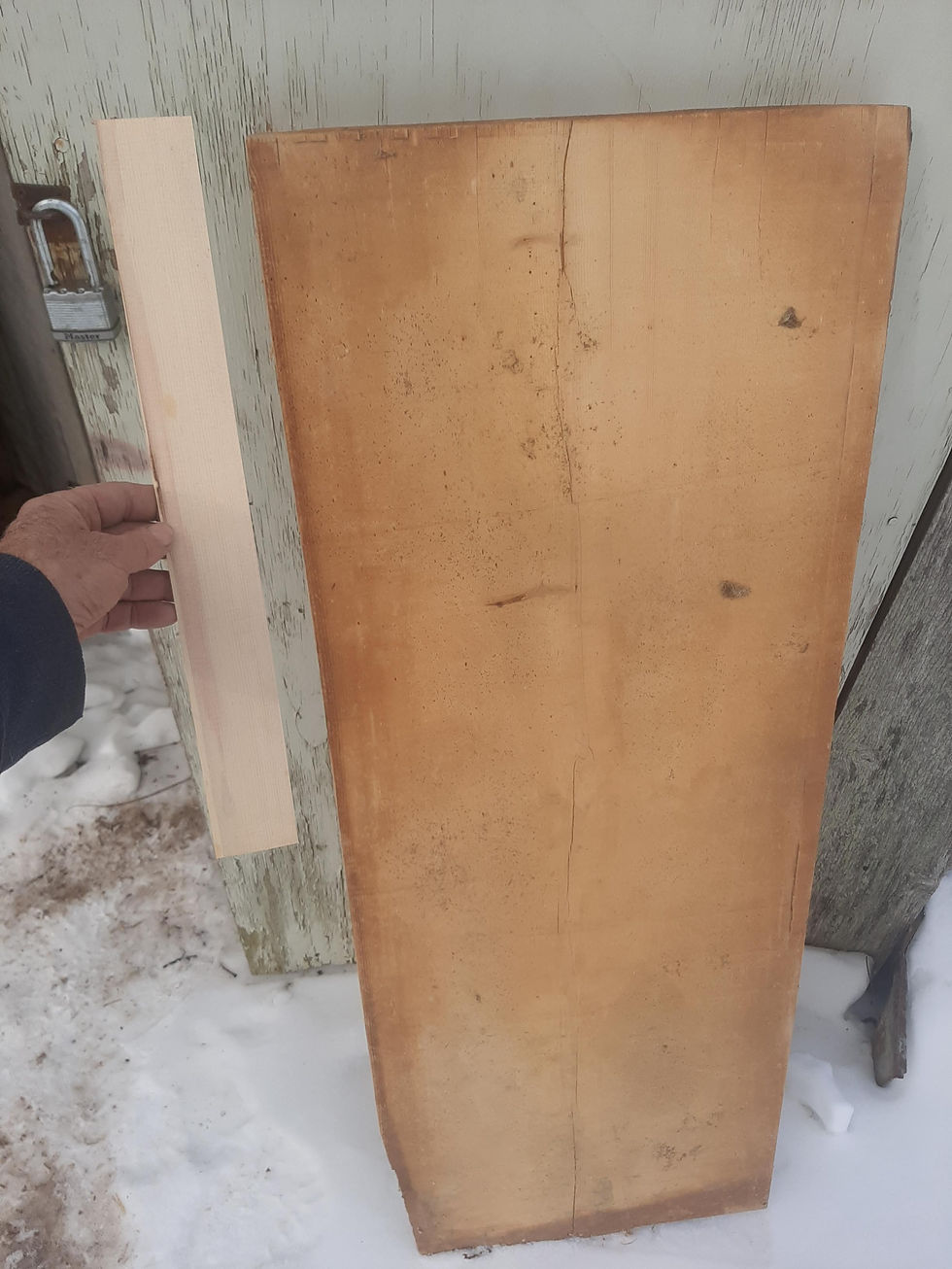

Sitka Spruce: This is the spruce that is most common in instruments because of the relatively large supply of it and quality. It is from the last remaining virgin stands of coastal spruce/ fir forest of the west coast. I got this in the mid 80's, when on my apple trip I was driving along the coast and saw a boat building supply house, and sure enough they had the most amazing planks of 20' long clear, quartersawn sitka spruce used for high end wooden boat building. It still takes my breath away thinking about the length, uniformity and perfection of that wood. Too good to be true. Shamefully, they cut this up into 6' lengths and I piled these under my sleeping arrangement in the bed of my truck (copy and paste) and brought them home.
Later, as I was buying 2x6's at the lumber yard, there were clear, tight grained sitka spruce 2x6's being sold as building lumber. Hmmm i thought. It then occurred to me that when there is a republican regime in office there is a huge release of natural resources due to pro-business policy towards the natural environment and its resources. Years of the Reagan era, quoted as saying as governor of California "if you seen one redwood, then you have seen them all," had released large tracts of virgin forests to the logging industry. So next time when you need to know which party is in office, just go look at the quality of the wood in the lumber yard, for better or for worse.
White Spruce: This story takes place when I was taking my canoe for a trip around the Great Lakes in the early 90's. I had just turned 30, and was in a bit of an existential crisis. Rounding the top of Lake Superior I stopped at a welcome center in Marathon, Ontario, and noticed enormous logs lining the parking lot. They had huge metal cleats and chains linking them together. They also looked like old growth spruce. I went inside to inquire, and indeed they were spruce, and were used back in the day to corral loose, floating logs in the lake as they waited to be milled. I asked if there were more, and sure enough not far away, was a stack 20' high and covering at least an acre of these old logs. I got permission to cut "as many as you want". I went to the hardware store (remember I'm on a canoe trip with a B2000 pickup with a canoe on top) and rented a chainsaw, wedges and a sledge hammer, and set to work bucking up and breaking one 4' bolt down. This time it wasn't nice flat boards, it was clunky, splintery wedges 4' long. These slept next to me, instead of under me, all the way to Quebec City and then back home. I always wanted to go back and salvage that wood as a side hustle, and sell it to instrument makers, but my grasp wasn't that long. Years later I read it became popular to salvage logs like these that were submerged at the bottom of the lake at great expense for choice markets like instrument making.
Red Spruce: I was curious about the idea of a local spruce and the one we have in West Virginia is Red Spruce growing at elevations of 4000' plus. The next criteria is getting the growth rings the right density. This means the tree needs to be slow grown (if you understood the above question about wood density as it relates to growth). This also means it needs to grow slowly suppressed under an old growth canopy (climax , late succession forests) which are generally protected because of their rarity. I contacted the Forest Service in that ranger district I had heard managed a stand of old growth red spruce on Cheat mountain. They gave me permission to remove a fallen log provided I didnt use any heavy equipment. (This time under the Bush the Ist administration. Later I would ask again under the Clinton regime and would get an emphatic "no".) Just saying... I began my woodworking career at the formidable age of 22 making greenwood chairs and I would fell a tree, buck it up, and split out billets to be carried out on my shoulder, sometimes up a mountain slope! So this process was carried out in the context of a state park with nice flat trails on a beautiful freshly fallen specimen of red spruce that laid along a trail.

Desert ironwood: I'm not going to get preachy here, just giving the reason why I make some of the material choices for the Wiplstix. I have been particularly concerned about the finite resources of the planet in relation to the diversity of species and the importance of relationship of all things. I just dont think Wiplstix should take precedent over species extinctions. I one thinks about it it would be self defeating. If the world is trashed, then why have a travel fiddle to go see it? We all make choices and choose our sacrifices for our ideals. Fisheries are crashing all around so I don't eat seafood, as much as I adore sushi, and I don't use topical rainforest wood like the extremely, hard ebony which is the standard for instrument making where high wear is an issue like the fingerboards, nuts and saddles. As an alternative I sought out a wood called dessert ironwood which grows in Arizona, and is the densest wood on our continent. So dense that blacksmiths used to use it when coal wasn't available. Its a beautiful dark color not unlike ebony with gold brown streaks. Its a gnarly grained desert wood that is suitable for only the smallest of parts like the nuts at the end of the fingerboard, and the saddle where the cable from the tailpiece wraps around and anchors to the butt of the instrument. Fingerboards are traditionally made of ebony, but I use our local hickory for that.
It was on my last apple trip out west in the mazdarati in the mid 90's picking apples that I stopped off at friend's in Taos, NM. I borrowed his chainsaw and went back to Arizona to a place called the Whipple Mountains outside of Lake Havasu, where there is a patchwork population of desert ironwood. It didn't take me long to find some dead trees and I managed to cut one up (barely). I don't know if it was from the sand blown into the cracks of the wood or just the shear density of the wood, but my chainsaw chain quickly dulled and I am remorse to say I toasted the chain as well as the bar of my friend's chainsaw. I did make it through, smoke and all, dragged the heavy-as-lead log to my truck, and slept soundly (pun intended) next to it all the way home. I took it to my long time bandsaw guy to mill with some other logs, and he barely got through it saying to me between emphatic tobacco spits, "don't ever bring me another piece of that damn wood to me again".

Hickory: If I was forced to have a favorite tree it would be hickory. It is a species known for its stateliness, sturdiness, and fall color if nothing else. But it also produces the best flavored nuts I know of, and produces an amazing nut oil from its Bitternut species (Carya Cordiformis) you can buy seasonally on our nuttery website. It also produces a beautiful rich burgundy reddish wood that is tough and hard. This has been my local choice for fingerboards. I have always missed having the dramatic black of ebony that traditional fiddles have, but because of its weight, and where it comes from, I have elected for hickory. The boards I have were procured when I was at the height of my furniture making, and would sometimes buy logs from local commercial mills and have them cut up for whatever project I needed. Though now I cant recall why I had 18" wide 8/4 hickory custom milled into heavy as s%*t boards, but it is a life supply for Wiplstix which, in the case of all these woods, uses very little.
I like the fact that Wiplstix are a value dense product that don't use a lot of materials. I also like the fact that they bring so much joy to the people who buy them and share their music as they travel about. Anything that facilitates community and human connection these days is precious needed. I quit woodworking a long time ago because I didn't want to just make high end furniture for people's 5th homes, but I still make Wiplstix and birdhouses (quite often their 5th houses but that's different). I believe Wiplstix is an affordable, yet high integrity product. It is also something that is a unique personal creation I dreamed up, and still exclusively make 25 years later. They are a gift from me to you. I thank you for your interest in them, and I thank you for supporting me as I maintain a small cottage industry that does its best to make the world a more fun, diverse, and beautiful place.
Treely Yours, Bill Whipple
1/30/ 63
(day of my 63rd birthday)
Love you blog https://appel.lol